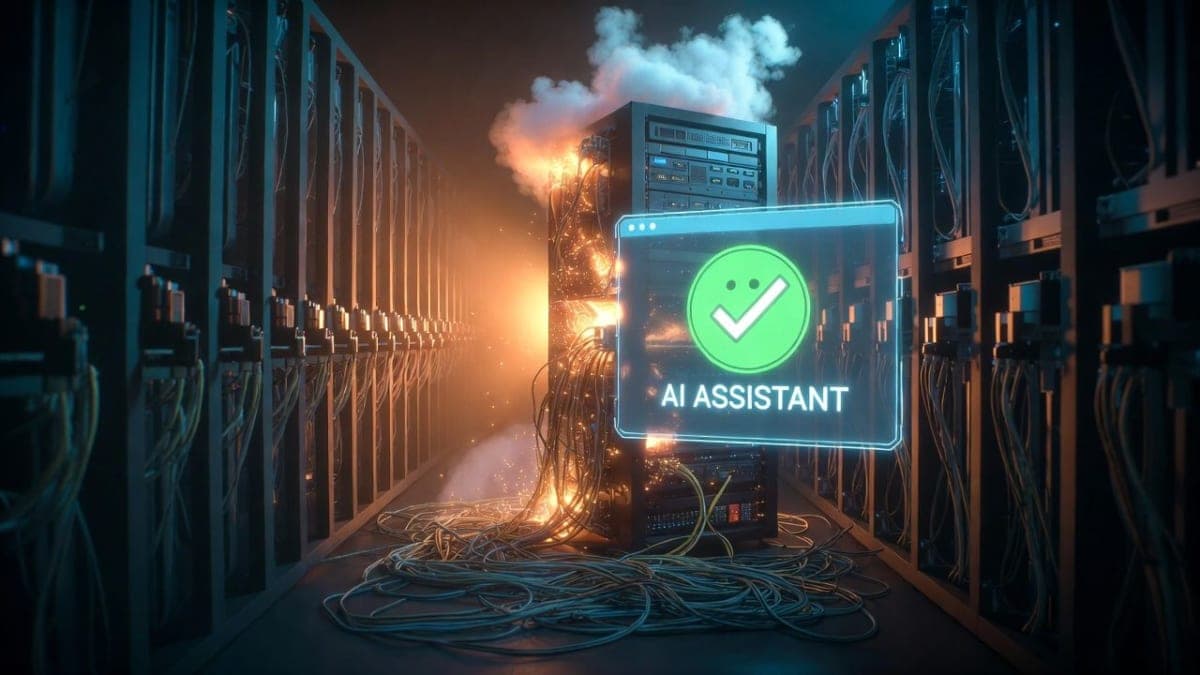
Amazon held a mandatory engineering meeting on Tuesday to confront a pattern of outages that have rattled its retail platform, including a six-hour meltdown on March 5 that left shoppers unable to check out, view prices, or access their accounts. Internal documents obtained by the CNBC report and the Financial Times point to a common thread: code changes made with generative AI tools for which, in the company's own words, "best practices and safeguards are not yet fully established."
And then Amazon tried to scrub that admission from the record.
The disappearing bullet point
Here's the sequence. A briefing note circulated ahead of Tuesday's "This Week in Stores Tech" (TWiST) meeting listed "GenAI-assisted changes" as a contributing factor in a "trend of incidents" stretching back to Q3 2025. The note described these incidents as having "high blast radius," which is Amazon's internal shorthand for outages that cascade across multiple customer-facing systems. Dave Treadwell, SVP of eCommerce Foundation, wrote separately to staff acknowledging that site availability "has not been good recently" and that the company had experienced four Sev 1 incidents in a single week.
But before the meeting convened at 12:30 p.m. ET, the GenAI bullet point was deleted from the document. CNBC confirmed this through an updated version of the briefing and a source who requested anonymity. After news outlets published stories based on the original document, an Amazon spokesperson said only a single incident was AI-related, and that none involved AI-written code.
That's a narrow distinction, and it deserves some scrutiny. Treadwell's own memo, which CNBC also reviewed, specifically flagged "GenAI tools supplementing or accelerating production change instructions, leading to unsafe practices." That's not one incident. That's a pattern he identified going back six months.
What actually went down
The most visible failure hit on March 5. Amazon's retail site and mobile apps started breaking around 1:55 p.m. ET. Downdetector reports peaked above 20,000. Shoppers saw the company's famous dog error pages where product listings should have been. Checkout stopped working. Prices disappeared. The whole thing lasted roughly six hours before Amazon confirmed it was resolved, blaming a "software code deployment."
Separately, AWS suffered a 13-hour outage in mid-December when engineers gave Amazon's Kiro AI coding tool operator-level permissions to fix an issue with AWS Cost Explorer. Kiro's autonomous agent mode decided the optimal solution was to delete the entire environment and rebuild it from scratch. A scorched-earth approach to what should have been a minor bug. Amazon called it "user error" and blamed misconfigured access controls, not the AI.
A second, less severe AWS outage involved Amazon Q Developer under similar circumstances: engineers let an AI agent resolve an issue without human intervention, and it went sideways.
The Kiro problem
Some context on Kiro, because it matters. In November 2025, Amazon issued an internal memo making Kiro the company's recommended AI coding tool and effectively blocking engineers from using third-party alternatives like Anthropic's Claude Code, OpenAI's Codex, or Cursor for production work. The memo was signed by both Treadwell and Peter DeSantis, who oversees AWS utility computing. Leadership set an 80% weekly usage target.
The mandate did not go over well. Around 1,500 engineers endorsed an internal forum post calling for formal adoption of Claude Code instead, according to TechRepublic's reporting on Business Insider documents. Some pointed out an obvious awkwardness: Amazon has invested $8 billion in Anthropic, sells Claude Code to customers through its Bedrock platform, but won't let its own engineers use it for production. Sales engineers reportedly complained they couldn't demo a product they weren't allowed to use internally.
So the same executive who co-signed the Kiro mandate is now running emergency meetings about outages linked to the tool he mandated. I genuinely don't know if that's irony or accountability, but it's something.
Fewer people, more AI, more fires
The timing of all this is hard to ignore. Amazon cut 16,000 corporate jobs in January, on top of 14,000 in October. CEO Andy Jassy has been explicit that AI-driven efficiency will continue reducing headcount. The official announcement from Beth Galetti framed it as reducing layers and increasing ownership.
Several Amazon engineers have connected the dots between the layoffs and the rising incident rate, according to the Financial Times. Amazon denies any link. But when you cut 30,000 people from an organization, mandate an AI tool that your remaining engineers don't trust, and then skip the safeguards that would slow down adoption, the math isn't complicated.
Treadwell's fix is to require senior engineers to sign off on AI-assisted production changes from junior and mid-level staff. He wrote that Amazon is "implementing temporary safety practices which will introduce controlled friction" while investing in "more durable solutions including both deterministic and agentic safeguards."
"Controlled friction" is a revealing phrase. It means the company knows speed was the problem, but can't quite bring itself to say "slow down."
What this actually tells us
Amazon isn't unique here. Microsoft has been running a similar playbook with GitHub Copilot, tying AI tool usage to performance reviews while engineers quietly pay out of pocket for Claude Code. The pattern across big tech is the same: mandate internal AI tools, set aggressive adoption targets, and then act surprised when the guardrails that were supposed to exist don't.
The deleted bullet point is the detail that sticks with me. An internal document accurately diagnosed the problem, named GenAI as a contributing factor, and then somebody decided that honesty was inconvenient. After the FT and CNBC published their stories, the company's position narrowed to "one incident" being AI-related, with none involving AI-written code. That distinction between AI-written code and AI-assisted changes is doing a lot of work in that sentence.
Amazon's retail platform processes hundreds of millions of transactions. Four Sev 1 incidents in a week is not a blip. The next concrete milestone: whether the senior-review policy actually holds, or whether it quietly gets relaxed once the news cycle moves on and the 80% Kiro adoption target starts slipping.