Researchers from Japan's National Institute for Materials Science and three partner universities report they've fabricated single-variant ruthenium dioxide thin films that definitively exhibit altermagnetism, a magnetic phase that has sparked fierce debate since experiments began yielding contradictory results around the world. The study, published in Nature Communications in September 2025, could reinvigorate efforts to build memory chips that sidestep the density limitations plaguing conventional magnetic storage.
The problem with today's memory
Ferromagnetic materials, the stuff of hard drives and MRAM chips, have an annoying vulnerability: stray magnetic fields can impact the performance if the part is unshielded, as one Freescale application note puts it rather diplomatically. As memory cells shrink, neighboring bits start interfering with each other. Pack them dense enough and the whole scheme falls apart.
Antiferromagnets dodge this issue by having their atomic magnetic moments cancel out, yielding zero net magnetization and immunity to external fields. But that cancellation creates a different problem: because their atomic-level spins cancel each other out, it is difficult to electrically read information from them. You can write data all you want, but good luck getting it back out.
Altermagnets, at least in theory, thread this needle. They maintain zero net magnetization like antiferromagnets while still producing the spin-polarized currents needed for electrical readout. Like antiferromagnets, they have no net magnetization, yet they still allow electrical readout of spin-dependent signals. That combination has made them a growing obsession in spintronics research.
RuO2: Poster child or problem child?
Ruthenium dioxide became the go-to candidate for altermagnetism research after theoretical predictions suggested its crystal structure should produce the right behavior. And for a while, positive results kept rolling in. Many subsequent studies reported positive indications for altermagnetism in RuO2, including observations of anomalous Hall effects and spin-polarized currents.
Then came the backlash. RuO2 is one of the most studied altermagnetic candidate materials. However, it has recently been scrutinized as evidence emerged for its lack of any magnetic order, according to a terahertz spectroscopy study published in npj Spintronics in May 2025. Muon spin rotation experiments found magnetic moments below their detection limits. A Physical Review Letters paper declared the absence of altermagnetic spin splitting character altogether.
The inconsistency has been maddening. Experimental results concerning altermagnetism in RuO2 have been inconsistent worldwide, hindering a clear understanding of its fundamental nature. Some labs see clear signatures; others see nothing.
The single-variant breakthrough
The Japanese team, led by researchers Zhenchao Wen and Cong He at NIMS, identified a culprit: sample quality. Most RuO2 films contain multiple crystal variants oriented in different directions. If the magnetic properties depend on crystal orientation, as altermagnetism theory predicts, then randomly mixed variants would wash out the signal.
The researchers liken the process to laying tiles on a floor. When tiles are randomly oriented, no clear pattern emerges. Align them in a single direction, and the structure becomes obvious.
They achieved this alignment by growing RuO2 films on sapphire substrates with a specific crystal face. The oxygen atoms on the sapphire surface template the RuO2 growth, forcing it into a single orientation. Their first-principles calculations found the preferred configuration had a formation energy 1.2 joules per square meter lower than the competing variant.
What they actually measured
The team used X-ray magnetic linear dichroism to probe the spin arrangement. This technique is sensitive to magnetic order even when net magnetization cancels out, making it ideal for altermagnets. XMLD can distinguish compensated magnetic structures and the formation of charge quadrupoles, undetectable by X-ray magnetic circular dichroism.
The angular dependence of the XMLD signal matched what you'd expect for a single magnetic domain with the Néel vector pointing along the [001] crystallographic direction. Temperature-dependent measurements showed the signal declining as samples approached 390 K, consistent with the expected transition to a paramagnetic state.
They also observed spin-splitting magnetoresistance in films capped with a ferromagnetic CoFeB layer. The resistance change showed an angular shift consistent with tilted spin currents, a hallmark of the altermagnetic effect.
The skeptics remain
Whether this resolves the controversy depends on how much weight you give to sample preparation. The bulk crystal studies showing no magnetic order used different growth methods. No magnetic transition occurs below 400 K in high-purity bulk single crystals, according to a Communications Materials paper from August 2025 that characterized RuO2 with a residual resistivity ratio of 152.
One theoretical explanation for the discrepancy: RuO2 sits near a quantum phase transition. The ongoing controversy surrounding the altermagnetism of RuO2 can be resolved by recognizing that its fragile altermagnetic state arises from its proximity to an LP instability, argues a preprint invoking Landau-Pomeranchuk instabilities. Strain, doping, or defects could tip the material one way or the other.
The NIMS team acknowledges this sensitivity. The discrepancies may be due to sample-to-sample variations, especially differences in growth conditions, Ru or O vacancies, and structural uniformity.
What comes next
Memory applications remain distant. The films are 30 nanometers thick, orders of magnitude larger than what production memory cells would require. And nobody has demonstrated actual data storage in an altermagnetic device.
But the synchrotron techniques the team developed for characterizing altermagnets could accelerate material discovery. The synchrotron-based magnetic analysis methods established during the study are also expected to help researchers identify and study other altermagnetic materials.
The FTC won't be issuing any injunctions about altermagnetic memory. Neither will investors be cashing out on altermagnet ETFs. This is basic materials research, with all the incremental progress and contested claims that entails. But if the single-variant approach holds up, RuO2 might finally stop being spintronics' most frustrating material.
IMAGE PROMPT
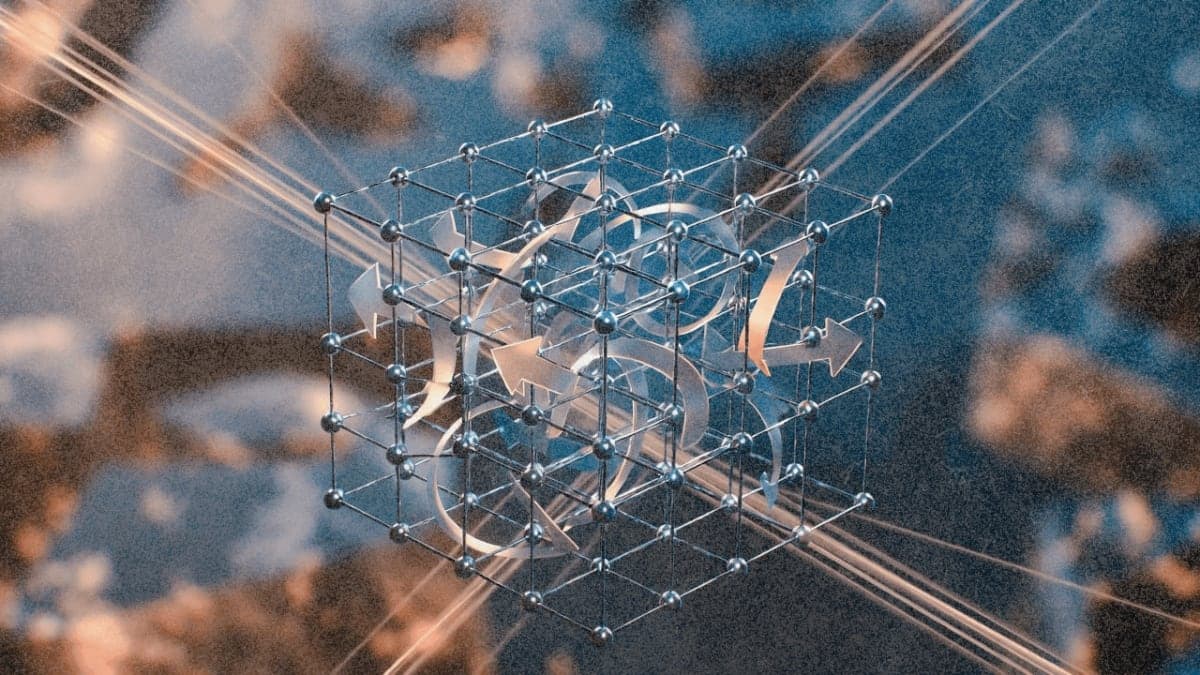
Editorial illustration in a technical-magazine style: A crystalline lattice structure of ruthenium dioxide rendered in metallic silvery-blue, with abstract representations of electron spins shown as opposing arrows in alternating sublattices. The lattice floats above a blurred sapphire substrate, with faint synchrotron X-ray beams (depicted as thin golden lines) intersecting the crystal at various angles. Cool color palette dominated by deep blues and metallic silvers, with warm amber accents from the X-ray beams. Sharp focus on the crystal structure, slight atmospheric haze in background. Photorealistic materials with diagrammatic overlay elements. 16:9 aspect ratio, suitable for web feature header.
featuredImageAlt: Artistic rendering of ruthenium dioxide crystal lattice structure showing alternating spin orientations characteristic of altermagnetic materials
EDITOR NOTES
- Suggested internal links: Previous coverage of spintronics developments, explainers on magnetic memory technology, materials science coverage
- Recommended external sources: Nature Communications original paper (DOI: 10.1038/s41467-025-63344-y), NIMS press release, npj Spintronics skeptical study
- Content freshness date: Update when follow-up studies confirm or contradict findings, or when competing groups publish on same topic
- Verification needed: The 390 K Néel temperature measurement should be verified against other sources; the 1.2 J/m² formation energy difference is from the paper but exact calculation parameters were not independently verified
- Dates to verify: September 24, 2025 publication date is confirmed in source; May 2025 date for npj Spintronics paper should be verified against actual publication
Suggested External Links
| Anchor Text | URL | Location in Article |
|---|---|---|
| published in Nature Communications | https://www.nature.com/articles/s41467-025-63344-y | Lead paragraph |
| Freescale application note | https://www.nxp.com/docs/en/application-note/AN3525.pdf | "The problem with today's memory" section |
| npj Spintronics in May 2025 | https://www.nature.com/articles/s44306-025-00083-2 | "RuO2: Poster child or problem child" section |
| Communications Materials paper from August 2025 | https://www.nature.com/articles/s43246-025-00905-0 | "The skeptics remain" section |
| preprint invoking Landau-Pomeranchuk instabilities | https://arxiv.org/html/2501.13616 | "The skeptics remain" section |
| NIMS press release | https://www.nims.go.jp/eng/press/2025/09/202509240.html | "Editor Notes" reference |