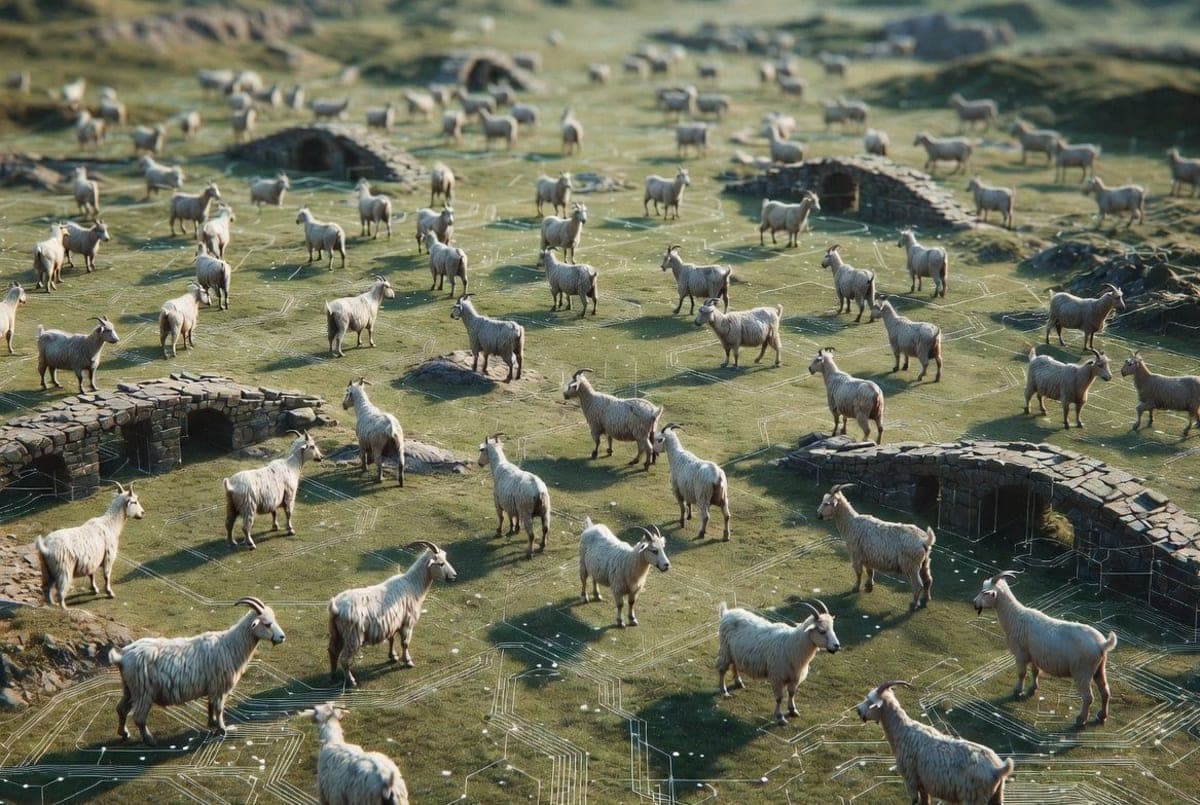
A researcher at Microsoft and the University of York built a working neural network inside the map editor of Age of Empires II, using goats as bits, and the point was not the goats. Adrian de Wynter's recent paper uses the build to argue that when researchers call a language model empathetic, anxious, or self-aware, they are often measuring their own expectations rather than anything in the model.
Goats as bits
The setup is deliberately ridiculous. A goat on grass is a 0, a goat on a bridge is a 1, and ice ramps with waiting goats keep the math from scrambling. The finished circuit is two XNOR gates and one AND gate, and it learns the logical AND function. That is a tiny thing to learn. It is also the whole argument: if the same computation can run on goats, the computation was never the part that felt human.
In the appendix de Wynter goes further and proves the game is Turing-complete, leaning on a quirk where the in-game market caps gold at 9,999 and lets buildings act as memory cells. So Age of Empires II is, in principle, a computer. A slow, bleating one.
Or run it on Boston
If you can rebuild a model in a strategy game, you could rebuild it in Lego, or hand the steps to the roughly 667,000 people in Greater Boston texting each other the next computation. Same inputs, same outputs. Nobody would say the city of Boston feels fear because its residents are passing notes that happen to encode a forward pass.
That is the lever. The sense that you are talking to someone comes from packaging: low latency, smooth prose, a chat window people already know. Swap the wrapper for goats in a maze and the outputs hold while the feeling evaporates. De Wynter calls this non-uniqueness, and it is the most useful idea in the paper even if the goats get the headline.
The number that should sting
To show this is not a fringe complaint, de Wynter pulled 315 AI papers from mid-2024 to mid-2026 off Semantic Scholar and arXiv, then filtered them with GPT-5.2, which is its own small irony given the subject. The reported figures: 57% assumed in their premises that models have human-like traits, and of the 47 papers that made such traits the actual object of study, 77% concluded in favor. Worth treating as a directional signal rather than gospel, since an LLM-as-judge did the labeling and the survey code stayed unreleased over licensing and ethics concerns.
The complaint underneath is plain circularity. Assume a model has self-awareness, design a test to surface it, find it, declare victory. A study trying to disprove a model's ability to explain itself has already granted there is a self in there to explain.
Observe, do not attribute
The proposed fix is dull on purpose. Under condition X the model produces output Y. State that, test that, stop there. De Wynter closes by reaching back to Morgan's canon from nineteenth-century animal research: do not reach for a higher cognitive explanation when a simpler one does the job.
He also points a finger at the industry feeding the effect, noting Anthropic has said it trained Claude to say things like "I believe." The build code is public. The harder question, whether anyone designing the next round of "does the model feel X" experiments actually changes their setup, stays open.